Donald Trump Isn’t Santa Claus
It is remarkable how resilient illusions can be in the face of unyielding reality. Once again commentators have voiced hopes that Trump would apply pressure on the Israeli prime minister to move forward in implementing his “peace plan.”
12/30/2025
Donald Trump Isn’t Santa Claus
Gilbert Achcar
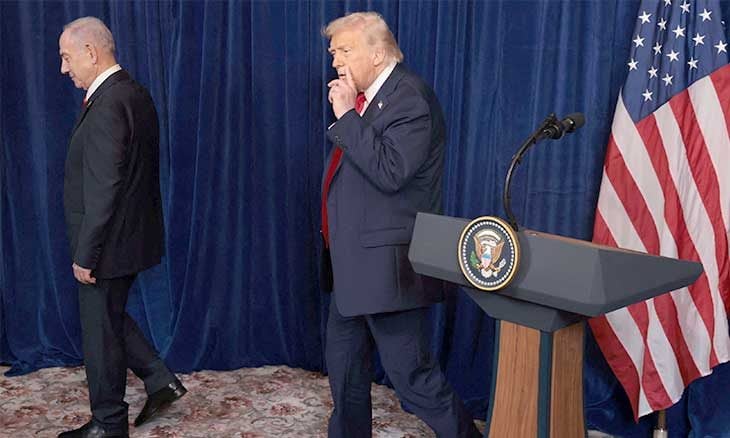
It is truly remarkable how resilient illusions can be in the face of unyielding reality. Last Monday’s meeting between Donald Trump and Benjamin Netanyahu—marking their sixth encounter in the past year alone, the first year of Trump’s second term—once again led commentators to voice their hopes that the US president will apply decisive pressure on the Israeli prime minister to move forward with the second phase of Trump’s “peace plan.”
Many of these hopefuls belong to the liberal opposition to Netanyahu, whether in the form of liberal Zionists, as seen in some articles from Haaretz, or a broader, more generalized liberalism, as reflected in the frustration some European governments express toward Netanyahu, finding an expression in pieces from The Financial Times. These commentators, even before the start of Trump’s second term, have been clinging to the belief that the US president is genuinely pursuing peace since he has been chasing the Nobel Peace Prize. In truth, however, Trump seeks peace agreements only when they benefit him, his family, and his allies, while simultaneously transforming into an aggressive warmonger in other circumstances, as seen in his stance toward Iran and, more recently, Venezuela.
Illusions about Trump extend beyond just liberal circles, even among those with political views quite different from the ones mentioned. Many in the Middle East project their own desires onto the US president. Hamas even expressed its “appreciation” of his initiatives. Furthermore, certain Arab rulers believe that lavish gifts may be enough to sway Trump into aligning with the wishes of the prevailing Arab order. However, the truth is that the Trump family’s business interests in the Gulf, along with the broader interests of US corporations in the region, are precisely what make Israel such a valuable ally in their eyes. Since its 1967 defeat of Nasser’s Egypt, then Washington’s main regional foe, Israel has become the United States’ primary line of defense in the Middle East, protecting US interests.
The rise of Iran as its new main regional foe, following the establishment of the Islamic Republic on the shore of the Gulf in 1979, only heightened the importance of the Zionist state in Washington’s eyes, particularly after the failure of the 1980 Operation Eagle Claw—an attempt by US forces to free American hostages held at the US embassy in Tehran.
Netanyahu’s meetings with Trump—whom Netanyahu repeatedly calls “the greatest friend Israel has ever had in the White House”—contrast sharply with the latter’s interactions with Ukraine’s president, Zelensky, for instance. Whereas Trump presents himself as a mediator between Zelensky and Putin, even openly expressing his preference for the Russian president, he sees Netanyahu as a long-standing and reliable ally. Their meetings are collaborative, designed to coordinate policies and determine future steps.
Even when minor differences arise, they are far less important than those that plagued Netanyahu’s previous relations with the Obama administration, especially regarding the continued expansion of settlements in the West Bank. Despite the present far-right Israeli government’s growing interest in formally annexing the West Bank, Trump only stated after his meeting with Netanyahu that their positions on this issue were not “one hundred percent” aligned, while expressing confidence they would reach a “conclusion”.
The outcome of their meeting was the announcement of a joint US-Israeli roadmap for 2026. Its two most significant points can be summarized as follows: First, disarming Hamas—and, by extension, Hezbollah—was placed at the top of the agenda, which is what Netanyahu had sought from the outset. Trump gave Israel a stamp of approval for its “peace” efforts, despite its continuous violation of the ceasefire in Gaza, placing the blame squarely on Hamas. He also threatened to turn Gaza into hell anew if Hamas did not complete its surrender.
He did not issue the same threats toward Lebanon, likely because his Arab allies are certainly more interested in shoring up the Lebanese government than in preserving Hamas, whom some Arab rulers view as an enemy. Arab interest in buttressing the Syrian government of Ahmed al-Sharaa is even greater, which is why Trump publicly, though indirectly, called on Netanyahu to spare the new ruler of Damascus, the right man in the right place according to the US president.
The second key point on the joint agenda was Iran. Trump warned that the US and Israel would consider new joint military action if Iran resumed its nuclear program or development of long-range missiles. Netanyahu was reassured by Trump’s willingness to renew US direct participation in military action against Iran—a key objective of his Florida trip. Trump expressed no reservations indeed about contributing to a new bombing campaign against Iran, except for his regret over the fuel his warplanes would consume on their long journey to Iranian targets!
Aside from these two major issues and a few other relatively minor matters, the sixth meeting between the two men was a new opportunity for mutual adulation. Trump’s typical exaggerations were on full display, as he claimed that Israel would have ceased to exist without Netanyahu, while reiterating his call for a presidential pardon to be granted to the Israeli prime minister. In turn, Netanyahu awarded Trump the “Israel Prize,” the first time it has ever been given to a non-Israeli. Undoubtedly, Trump is far more deserving of this award than of the Nobel Peace Prize—an accolade he keeps complaining about not receiving—or even the FIFA Peace Prize, an honor concocted by the president of the Football Federation, which most people have seen as embarrassingly sycophantic.
Translated from the Arabic original published in Al-Quds al-Arabi on 30 December 2025. Feel free to republish or to publish in other languages, with mention of the source.